 Call us: 507-494-5169
Why Push-Pull MIG Guns Are a Smart Choice for Aluminum Welding
Posted by Weldfabulous on Sep 1st 2026
Why Push-Pull MIG Guns Are a Smart Choice for Aluminum Welding
Aluminum brings plenty of advantages to the table, but feeding aluminum wire through a MIG welding system can present some challenges.
Because aluminum welding wire is softer than steel wire, maintaining consistent wire feeding becomes especially important. That's where a push-pull MIG gun can make a difference.
Designed to help maintain smooth, consistent wire delivery from the feeder to the gun, push-pull systems are a popular solution for aluminum welding applications. Whether you're working in fabrication, manufacturing, repair, or another industrial setting, understanding how these systems work can help you decide if a push-pull setup is right for your application.
Why Is Aluminum Wire More Difficult to Feed?
One of the biggest differences between MIG welding aluminum and steel is the wire itself.
Aluminum wire is relatively soft and can be more difficult to push through a long gun cable. As the distance between the wire feeder and welding gun increases, maintaining smooth wire delivery can become more challenging.
Poor wire feeding can contribute to issues such as inconsistent feeding, tangling, and interruptions during welding.
For welders who regularly work with aluminum, improving control of the wire from the feeder to the contact tip can help create a more dependable setup.
How Does a Push-Pull MIG Gun Work?
As the name suggests, a push-pull system uses two feeding mechanisms working together.
The main wire feeder pushes the welding wire through the cable while a drive system located in the gun pulls the wire toward the contact tip.
Working together, the two systems help maintain more consistent wire delivery over longer distances.
This design is particularly useful with softer wires like aluminum, but many push-pull guns can also accommodate other wire types depending on the gun and setup.
Why Use a Push-Pull Gun for Aluminum?
More Consistent Wire Feeding
Reliable wire feeding is important for any MIG application, but it becomes especially important when working with soft aluminum wire.
By controlling the wire at both the feeder and the gun, a push-pull system can help provide smooth, consistent delivery throughout the welding process.
Greater Reach
Being tied closely to a stationary wire feeder isn't always practical.
Push-pull guns are available with longer leads, giving welders additional reach when working around large parts, assemblies, vehicles, trailers, or fabrication projects.
MK Products offers several of its push-pull MIG guns in lead lengths ranging from 15 to 50 feet.
Control at the Gun
Depending on the model, push-pull guns can provide wire-feed adjustments directly at the gun.
That means the welder can make certain adjustments without repeatedly returning to the wire feeder, which can be especially useful when working farther away from the power source.
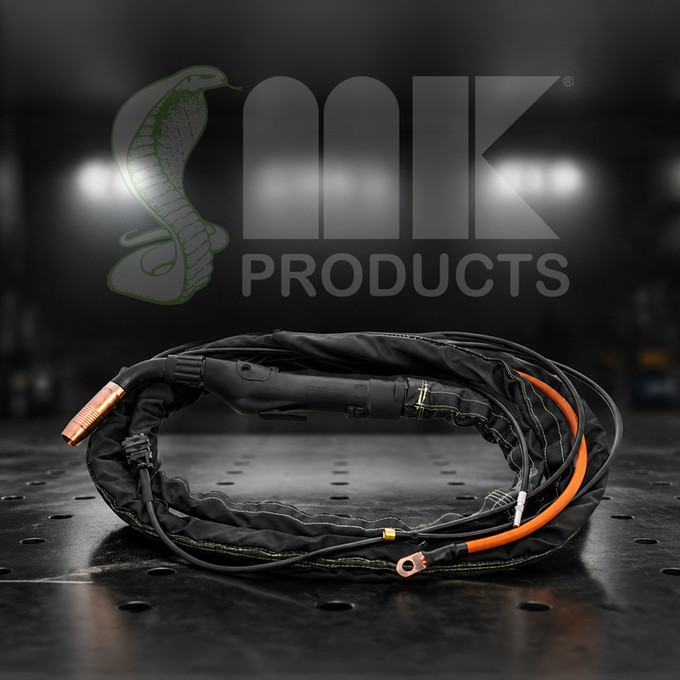
Meet the MK Products Python® Push-Pull MIG Gun
MK Products has been developing push-pull welding technology for decades, and the Python® is one of the company's best-known MIG gun designs.
The Python is designed for aluminum welding as well as steel, stainless steel, and flux-cored wire applications.
Features include:
- Fingertip wire-speed adjustment
- Forward trigger location
- Ergonomic, balanced design
- EZ-Lock® barrel with 360-degree rotation
- Multiple lead lengths
- Air-cooled and water-cooled options
- Compatibility options for several popular welding systems
For welders who need additional flexibility around the workpiece, air-cooled Python models can also accommodate an optional flexible barrel for hard-to-reach welds.
Air-Cooled or Water-Cooled?
Choosing between an air-cooled and water-cooled push-pull gun depends largely on the demands of the application.
Air-Cooled Python®
An air-cooled gun can be a practical choice for many general aluminum welding applications. MK Products' Python air-cooled models are rated at 225 amps at 100% duty cycle using argon.
Without a separate water-cooling system, the setup can also be simpler.
Water-Cooled Python®
For higher-output applications, a water-cooled gun may be the better choice.
MK Products' water-cooled Python models are rated at 400 amps at 100% duty cycle using argon and are designed for applications requiring higher output and extended welding.
The right choice ultimately depends on your welding amperage, duty cycle, work environment, and how heavily the gun will be used.
Don't Forget the Consumables
Keeping a MIG gun performing properly doesn't end with choosing the gun itself.
Contact tips, liners, drive rolls, gas cups, barrel components, and other wear items all play a role in wire delivery and overall gun performance.
Replacing worn components and using parts designed for the welding gun can help keep the system operating as intended.
Weldfabulous carries a variety of MK Products replacement parts and consumables, making it easier to maintain your equipment without replacing the entire gun.
Is a Push-Pull MIG Gun Right for You?
A push-pull system may be worth considering if you:
- Regularly MIG weld aluminum
- Need to feed soft wire over longer distances
- Want greater mobility around large workpieces
- Experience wire-feeding problems with your current setup
- Need wire-feed control closer to the weld
- Work in production or fabrication environments where consistent wire delivery is important
There isn't one welding gun that's right for every application. Your wire type, amperage, duty cycle, lead length, power source, and connection requirements should all be considered before choosing a gun.
Explore MK Products at Weldfabulous
From Python® push-pull MIG guns to replacement parts, consumables, and accessories, MK Products offers welding equipment designed to keep wire moving smoothly and welders working efficiently.
Explore MK Products available at Weldfabulous and find the equipment and replacement parts that fit your welding setup.